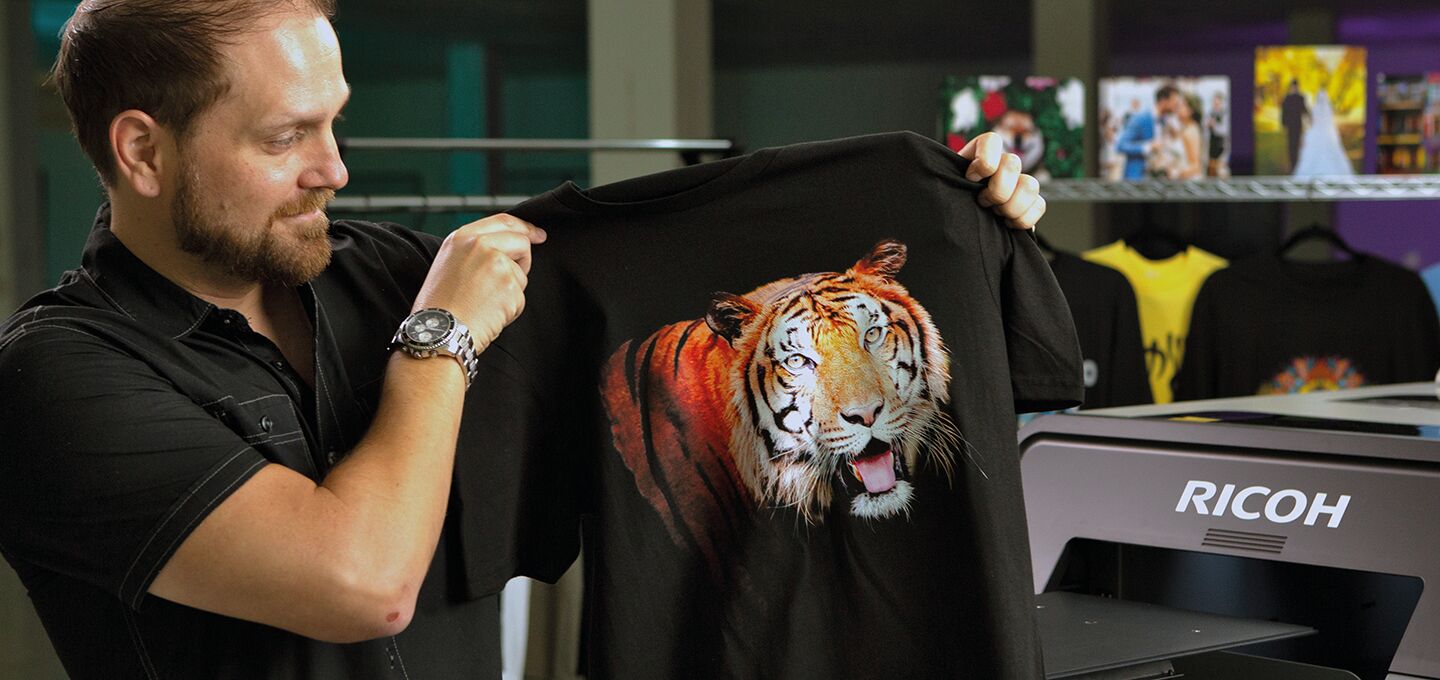
From limited drops to on-demand collections: digital textile printing lets fashion labels produce small runs without screens or minimum order quantities – with photographic detail and a soft hand-feel.
Typical applications
Fashion labels, online shops and designers use DTG and DTF wherever designs change quickly and quantities are hard to predict:
- Capsule collections and limited editions
- Print on demand for online shops – produced only when an order comes in
- Samples and prototypes for new collections before larger quantities are ordered
- Personalised pieces with names, numbers or individual motifs
DTG or DTF?
Direct-to-garment (DTG) prints water-based inks straight onto the garment. The print becomes part of the fabric and stays soft – ideal for cotton T-shirts, hoodies and sweatshirts with detailed, full-colour designs. Direct-to-film (DTF) first prints the design onto a transfer film, which is then pressed onto the textile. DTF works on cotton, polyester and blends – with the right hot-melt adhesive also on nylon and softshell – and is the better choice when a collection mixes different materials.
Suitable systems
- RICOH Ri 1000X – DTG with CMYK + white for light and dark garments, optionally also DTF: a versatile entry into fashion production.
- RICOH Ri 4000 – our most advanced DTG printer with integrated pre-treatment and dual mode for DTG and DTF, for growing on-demand production.
- RICOH XTF D430 “DTF Cube” – compact DTF system with automatic roll feeding and inline cutting, for transfers on mixed materials.
Good to know
- Dark garments need a white underbase. For DTG on cotton this also means pre-treatment – the Ri 4000 applies it automatically.
- Hand-feel and wash durability also depend on the textile itself, so test your blanks before production starts.
- Consistent colour across a collection is easier when all files are prepared with the same colour workflow.
Try it with your own collection
Bring your garments and designs to the RICOH Textile Competence Center near Frankfurt. Our application specialists print them with you using DTG and DTF, so you can compare the results side by side.