Direct-to-Film (DTF) and Direct-to-Garment (DTG) are the two digital processes that have changed textile decoration most profoundly in recent years. Both print full-colour designs without screens, without screen set-up costs and without minimum order quantities – and yet they work very differently. This guide explains the differences and helps you decide which process suits your orders, your materials and your production.
How DTG works
In direct-to-garment printing, water-based inks are applied directly onto the textile – using an inkjet printer designed for finished garments. The garment lies on a platen, the print head travels across it and prints the ink straight onto the fabric.
- Light-coloured textiles: The colours are printed directly onto the textile.
- Dark textiles: A white underbase is printed first so that the colours stay vibrant. On cotton this usually requires pre-treatment, which some systems – such as the RICOH Ri 4000 – apply automatically.
- After printing, the ink is cured with heat.
Because the ink partly sinks into the fabric, DTG prints feel soft – especially on light-coloured textiles, where no white underbase is needed. The process shows its strengths with highly detailed, photographic designs on cotton; systems such as the Ri 4000 also print on polyester.
How DTF works
In direct-to-film printing, the design is not printed onto the textile but onto a special transfer film:
- The printer applies the colours and a layer of white ink to the film.
- Hot-melt powder is applied to the still-wet print.
- The powder is melted and cured.
- The finished transfer is pressed onto the textile using a heat press.
The transfer can be applied immediately or stored and pressed later. This separation of printing and finishing is one of the key advantages of DTF.
The most important differences at a glance
| DTG | DTF | |
|---|---|---|
| Where the ink goes | directly onto the textile | onto a transfer film, then pressed on |
| Suitable materials | cotton and cotton blends; polyester with suitable systems (e.g. Ri 4000) | cotton, polyester and blended fabrics – with the right hot-melt adhesive also nylon and softshell (test beforehand) |
| Dark textiles | white underbase, with pre-treatment on cotton | the white layer is part of the transfer |
| Hand feel | very soft on light textiles; firmer with a white underbase | a thin transfer layer on the surface |
| Workflow | one step directly on the textile | print, powder, cure, press |
| Pre-production | only printed textiles can be put into stock | transfers can be pre-produced and applied as required |
When DTG is the better choice
- You mainly print cotton T-shirts, hoodies and sweatshirts.
- Your designs are photographic or highly detailed, and a soft hand feel matters – in fashion, for example.
- You produce one-offs and small runs on demand, directly on the finished garment.
When DTF is the better choice
- You decorate many different materials: cotton shirts, polyester sportswear, blended fabrics, bags – and, with the right hot-melt adhesive, nylon and softshell as well (always test the material beforehand).
- You want to pre-produce transfers and apply them when the order comes in, or pass them on to customers who press them themselves.
- You need logos and promotional designs on changing items in varying quantities.
Why many businesses use both
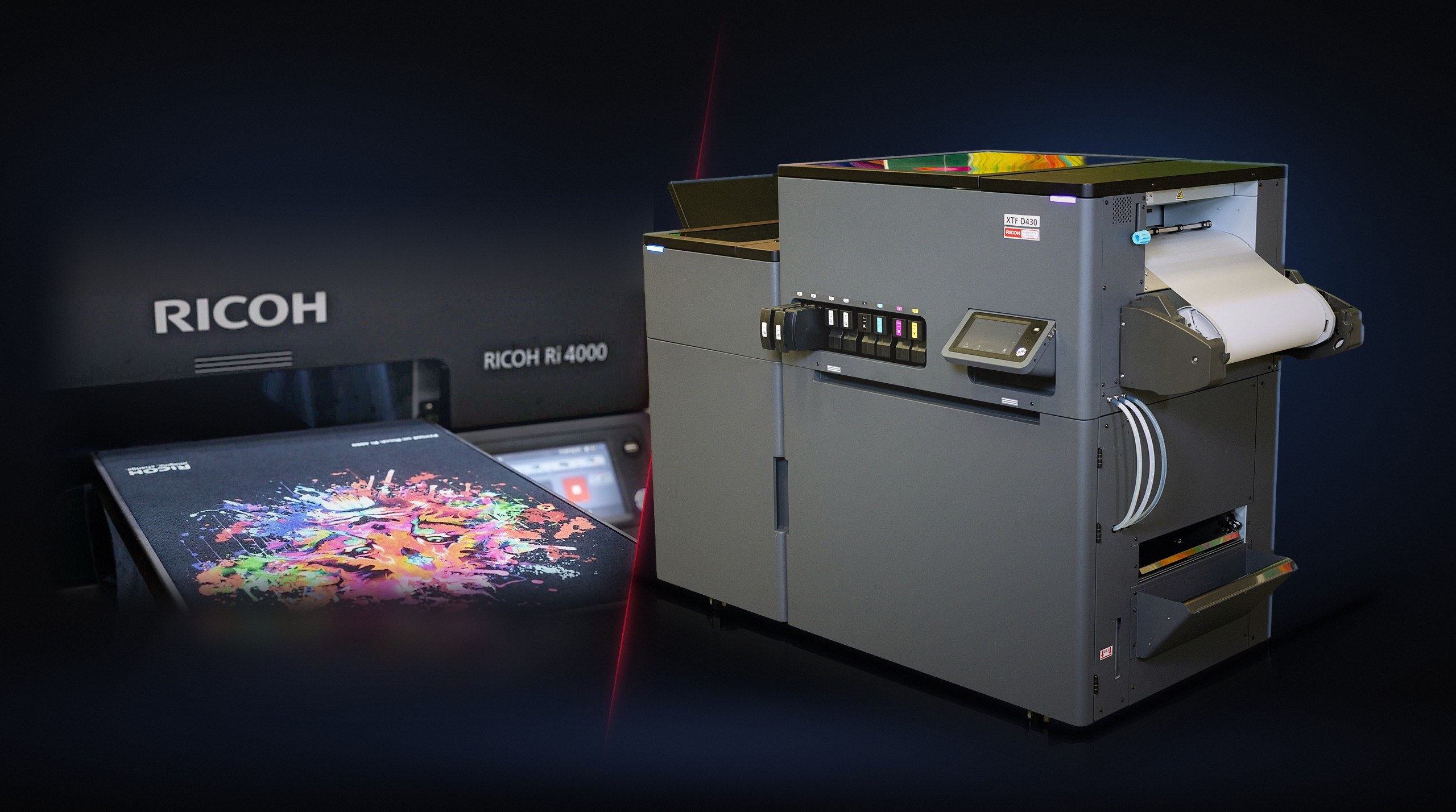
DTG and DTF complement each other well. Some systems even combine both processes: the RICOH Ri 1000X prints DTG and optionally DTF (with DTF film and powder), and the RICOH Ri 4000 offers a dual mode for DTG and DTF with integrated pre-treatment. For dedicated DTF production, RICOH offers two systems:
- the compact RICOH XTF D430 „DTF Cube“ with its unique sheet workflow
- the industrial RICOH Pro™ D1600, for high volumes and 24/7 operation
Questions to ask yourself before deciding
- Which textiles do you print most often – and which would you like to print in future?
- How large are your typical orders, and how quickly do they have to be delivered?
- Do you want to keep transfers in stock or only print once an order comes in?
- How much space do you have, and who operates the system?
- Should the system grow with you?
Compare both processes with your own textiles
The most reliable answer comes from a test with your own textiles and designs. At the RICOH Textile Competence Center near Frankfurt, our application specialists print them together with you using both DTG and DTF, so that you can compare colour, detail reproduction, hand feel and workflow side by side. Book a demo.